Reading the term sheet with your lawyer
Call with the lawyer, Monday evening
Founder Four pages. It says twenty-five post and five in, so they own twenty percent. That is the number we wanted.
Lawyer That is the number on page one. Page two is where the money is. Liquidation preference, one times, participating.
Co-founder Meaning what, in a sale.
Lawyer Meaning they take their five off the top, and then take a fifth of what is left as well. If it were non-participating they would pick a side instead of taking both.
Founder And that stays there for as long as they hold the shares.
Lawyer It does. Next: the option pool. They want twelve percent, created before their money lands. That comes out of your side of the table, not theirs.
Co-founder So the twenty-five is not really twenty-five.
Lawyer It is twenty-five with a hole in it. Anti-dilution is the ordinary kind here, not the harsh one. If it said full ratchet I would be telling you to walk.
Founder They also want their pro rata in the next round, and a board seat.
Lawyer Pro rata is fine and normal. The seat means three directors instead of two, and it comes with a list of things you cannot do without them — selling the company is on that list.
Co-founder A veto.
Lawyer A veto on named decisions, yes. And once you sign, the no-shop runs thirty days, so the other fund you are still talking to has to hear from you tomorrow, not later.
Founder Then let us take the pool argument first and the seat second.
The headline number is agreed in the first minute. The rest of the evening is spent on the sentences that decide what that number is worth on the day the company is sold.

A term sheet moves from price to power
The opening lines are arithmetic: what the company is called worth and how much is coming in. Then come the lines about a sale that may be years away, and the ones about who decides in the meantime. The last one is about how long you have to think.
Term sheet
A short document setting out the main terms of an investment, mostly non-binding, signed ahead of full legal documents.
We have a term sheet from them and it expires Friday.
Four pages that are mostly not binding and entirely decisive: whatever is conceded here comes back word for word in the documents that are.
Post-money valuationValoración post-money
The pre-money valuation plus the new investment, and the number the investor's percentage is calculated against.
$25M post, so their $5M is exactly 20%.
The number that gets said out loud and repeated to friends. Confused with the pre-money constantly, and the difference is the whole round.
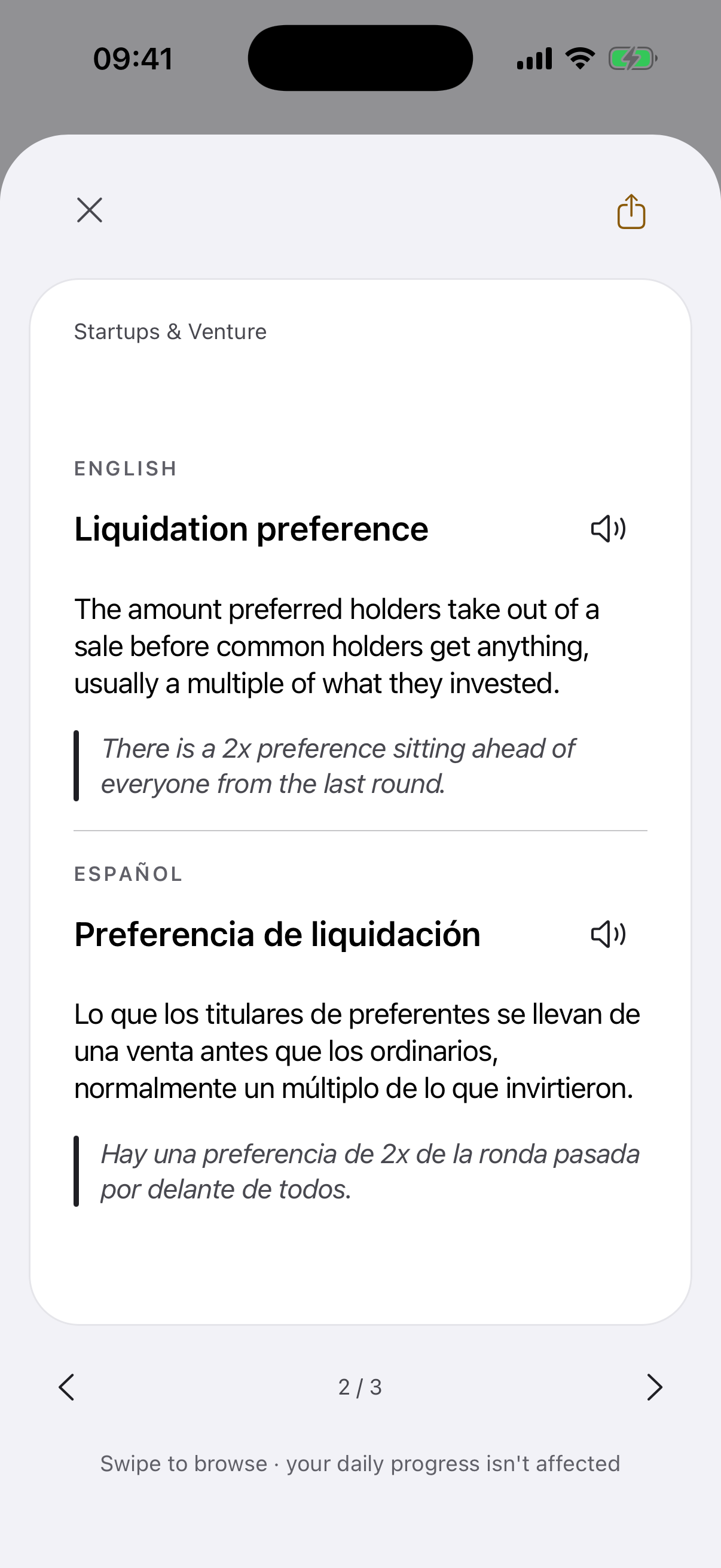
Liquidation preferencePreferencia de liquidación
The amount preferred holders take out of a sale before common holders get anything, usually a multiple of what they invested.
There is a 2x preference sitting ahead of everyone from the last round.
The clause that decides who gets paid first when the company is sold. At a good price nobody notices it; at a mediocre one it is the entire outcome.

Participating preferredPreferentes participativas
Preferred shares that are paid their preference first and then also share the remaining proceeds alongside common.
It is participating preferred, so they take the $10M off the top and still get their 20% of what is left.
The version where the investor is on both sides of the payout at once. Founders read it as a detail; lawyers read it as the point of the document.
Non-participating preferredPreferentes no participativas
Preferred shares whose holder must choose between taking the preference amount or converting to common, not both.
Standard non-participating 1x, so they take whichever side is bigger.
The version most rounds settle on, where one side has to be chosen. One word apart in writing, a different company in a sale.
Option pool shuffle
Creating or enlarging the option pool inside the pre-money, so existing holders rather than the new investor absorb that dilution.
They asked for a 12% pool pre-money, which quietly lowers our real price.
The reason the agreed valuation is quietly lower than the one being celebrated. It arrives as an administrative request about hiring.
Anti-dilution protectionProtección antidilución
A preferred-share right that adjusts the conversion price if the company later issues shares at a lower price.
Anti-dilution is broad-based weighted average, which is what we expected.
Insurance against a cheaper round later, paid for by whoever holds common stock. Almost every sheet has it; the argument is about which kind.
Full ratchet
The harshest anti-dilution form, repricing earlier preferred all the way down to the new lower price however few cheap shares were issued.
Full ratchet in a down round would flatten the common holders.
The kind that turns a bad quarter into a lost company. Rare enough that seeing it is itself information about the fund.
Pro rata rightsDerecho de pro rata
An existing investor's right to buy enough of a future round to keep the percentage they already hold.
The seed fund is taking its full pro rata in the A.
The right to keep the same slice by paying again next time. Not having it is how an early backer disappears from a company they believed in first.
Board seatPuesto en el consejo
A voting position on the board, usually granted to the lead investor of a priced round.
They want one board seat and one observer.
Where the relationship stops being a wire transfer and becomes a meeting every quarter.
Protective provisionsCláusulas de protección
A list of actions the company cannot take without the consent of the preferred holders.
Selling the company is a protective provision, so they hold a veto.
The quiet centre of the document: a short list of decisions that stop being yours alone. Selling the company is usually on it.
No-shop clauseCláusula de no-shop
A binding promise not to negotiate with other investors or buyers for a defined period after signing.
The no-shop runs 30 days from signature.
The one part of a term sheet that binds immediately, and the reason a founder makes an awkward phone call the same evening.

The lawyers turn four pages into forty
Every phrase conceded tonight comes back in the definitive documents, and by then it is drafting, not negotiation. The one reading it out loud will be you.
Questions and answers
What about the rest of the venture words?
On the deck page, all 150. These twelve are the ones a single term sheet uses.
Why is there Spanish on the card?
Term sheets are written in English wherever the company is registered, and read out loud in Spanish across the table. Both forms sit on one card, so nobody has to guess at "participating".
Where do the definitions come from?
From the Startups & Venture deck — the same cards as in the app.
The next sheet will turn on a different twelve.
The Startups & Venture deck holds the rest — in the app they come a few a day.